
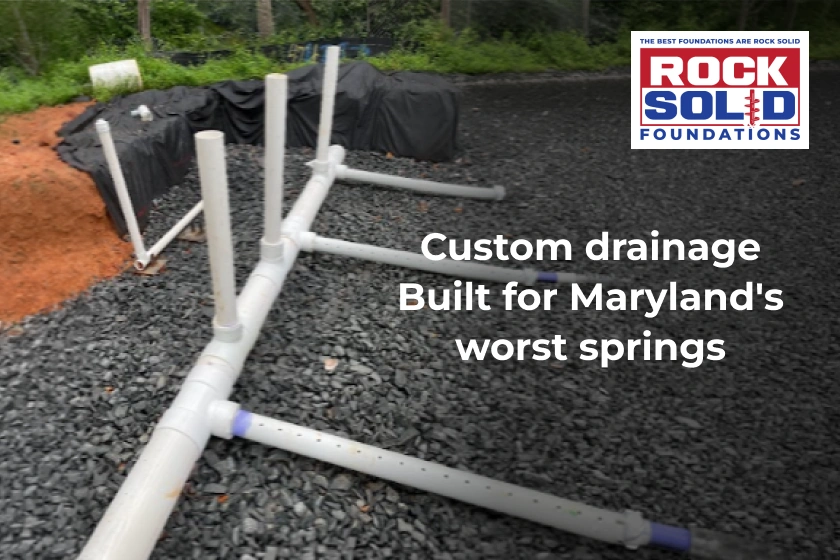
Spring in Maryland is beautiful, only until your basement floor tells you otherwise. After months of frozen ground and snowpack, April rain has nowhere to go. The soil is saturated, the runoff is relentless, and the problems that were quietly building all winter suddenly make themselves known.
For homeowners across Maryland and Delaware, spring is the season when drainage issues stop being background noise and start becoming expensive emergencies. The good news? Most drainage problems are fixable if you catch them early.
Here are five of the most common drainage problems that get dramatically worse every spring, and what you can actually do about them.
1. Negative grading: when the ground slopes the wrong way
Negative grading occurs when the soil around your home slopes toward the foundation rather than away from it. Every time it rains, water runs directly into the soil against your foundation wall, exactly where you don’t want it.
This problem is nearly invisible in dry seasons. In spring, when Maryland averages three to four inches of rain per month, it becomes a relentless pressure cooker. Water saturates the soil and builds up hydrostatic pressure against your foundation walls, leading to cracks, bowing, and eventual structural damage.
The fix: Professional regrading redirects surface water away from your home. A qualified drainage contractor will reestablish the proper slope; ideally, a six-inch drop over the first ten feet from the foundation, so runoff moves away from your house, not into it.
2. Clogged or undersized downspouts dumping water at the foundation
Your gutters and downspouts exist for one reason: to move roof water away from your home. When they’re clogged, undersized, or terminate too close to the foundation, they do the opposite; concentrating massive volumes of water directly against your structure.
Your gutters and downspouts exist for one reason: to move roof water away from your home. When they are clogged, undersized, or terminate too close to the foundation, they do the opposite, concentrating a significant volume of water directly against your structure with every storm.
The fix: Extend downspouts at least ten to twenty feet from the home using underground discharge pipes and pop-up emitters. This is one of the most cost-effective drainage solutions available, and it can dramatically reduce the volume of water stressing your foundation.
3. Standing water in the crawl space
Crawl space water is not a nuisance but an emergency. When water enters your crawl space and sits, it creates a breeding ground for mold, accelerates wood rot, and raises indoor humidity throughout the home. In spring, when groundwater tables are at their highest in Maryland, even a previously dry crawl space can suddenly flood.
The danger is that crawl space water is often invisible until real damage is done. By the time you smell mildew or notice sagging floors, the problem has already advanced.
The fix: A proper drainage solution for crawl space water typically involves interior drainage channels, a vapor barrier, and, in many cases, crawl space encapsulation, sealing the space entirely from ground moisture. Addressing the exterior drainage that’s feeding the problem is equally critical.
4. Failed or overloaded sump pump
Your sump pump is your last line of defense against basement flooding. But if it’s aging, undersized, or was barely keeping up last year, this spring could be the season it fails, right in the middle of a storm.
Warning signs that your sump pump is already struggling: it runs constantly during rain events, it’s more than seven years old, it makes unusual noises, or your basement has developed new water stains or moisture since last season.
The fix: Have your sump pump inspected before peak spring storms hit. A drainage contractor can assess whether your current system is adequate, recommend a battery backup for power outages, and redesign the surrounding drainage if the pump is being overwhelmed by volume rather than equipment failure.
5. Soil erosion around the foundation
Over time, repeated water flow strips away the soil around your foundation. As that soil erodes, it exposes your footings, the structural base your home sits on. Exposed footings are vulnerable to freeze-thaw cycles, water intrusion, and ultimately, settlement.
Spring accelerates erosion dramatically. Snowmelt and rain combine to scour soil from around the base of your home, and without intervention, drainage problems like this compound year after year.
The fix: Erosion control combines surface drainage engineering, strategic plantings, and in severe cases, helical pile installation to stabilize a foundation that has already begun to settle. The earlier erosion is addressed, the simpler and less expensive the solution.
Rock Solid Foundations: Maryland’s trusted drainage contractor
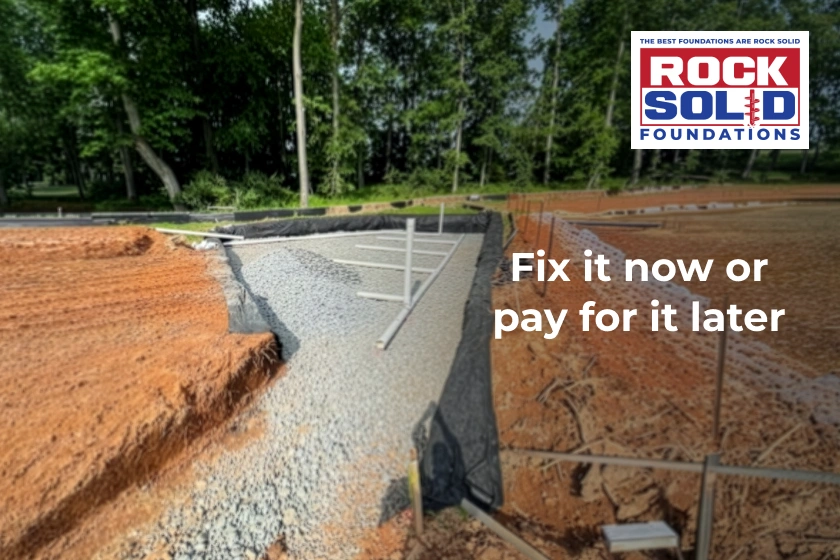
Rock Solid Foundations is a veteran-owned company with over 30 years of combined experience serving homeowners and businesses across Maryland and Delaware. We design every drainage solution around your property’s unique soil, water flow, and climate conditions, not a generic fix.
- Custom drainage system design tailored to your property
- French drain installation, downspout extensions, and sump pump installation
- Free on-site evaluation with no obligation and no pressure
- Flexible financing and military and first responder discounts available
- Proudly serving Annapolis, Anne Arundel County, and surrounding areas across Maryland and Delaware
Spring won’t wait. Neither should you. Schedule your free evaluation today and get ahead of the damage before the next storm arrives.
FAQs
1. Can poor yard drainage actually cause foundation damage?
Yes. When water isn’t directed away from your home, it saturates the surrounding soil, building hydrostatic pressure against your foundation walls. Over time, this causes cracks, bowing, and settlement. In Maryland, where clay soils retain moisture and spring rainfall is heavy, drainage failure is a leading cause of foundation damage.
2. What are the early warning signs of drainage problems around a foundation?
Look for water pooling within ten feet of your foundation after rain, soil pulling away from the foundation wall, water stains or white mineral deposits (efflorescence) on basement walls, a musty smell in the basement or crawl space, and a sump pump that runs constantly during storms.
3. Why do drainage problems get so much worse in spring?
Frozen ground thaws and temporarily becomes impermeable, so water can’t absorb into the soil. Combined with snowmelt and increased rainfall, this forces water to run along the surface and pool near the lowest points on your property, typically right against your foundation.
4. What’s the difference between a French drain and a curtain drain?
Both redirect groundwater using gravel-filled trenches with perforated pipe, but they serve slightly different purposes. A French drain is typically installed near the foundation or in low-lying areas to collect and redirect subsurface water. A curtain drain is installed uphill from a problem area to intercept groundwater before it reaches the foundation. A drainage contractor can assess which solution or combination fits your property.
5. When should I call a professional instead of trying to fix drainage myself?
DIY fixes like extending downspouts or adjusting mulch grades are fine for minor surface issues. Call a professional if you see cracks in your foundation walls, water entering through the foundation itself, a sump pump that can’t keep up, bowing or leaning walls, or standing water in your crawl space that doesn’t dry within 24 to 48 hours. These are signs the drainage problem has already affected your foundation.